
Finnish curly birch
One species, the whole chain
We walk the forests, buy the standing trees, saw them ourselves and grade every piece by hand. Nothing passes through a middleman, so we can tell you which tree your log or slab came from.
Curly birch is a naturally figured variant of silver birch. The grain twists and interlocks instead of running straight, which is why a finished handle seems to move when you turn it in the light. It occurs in roughly one or two of every hundred birch, and no amount of planting makes that number reliable.
We are in eastern Finland, where the good stands are. Most of what we cut leaves here as logs and live-edge slabs.
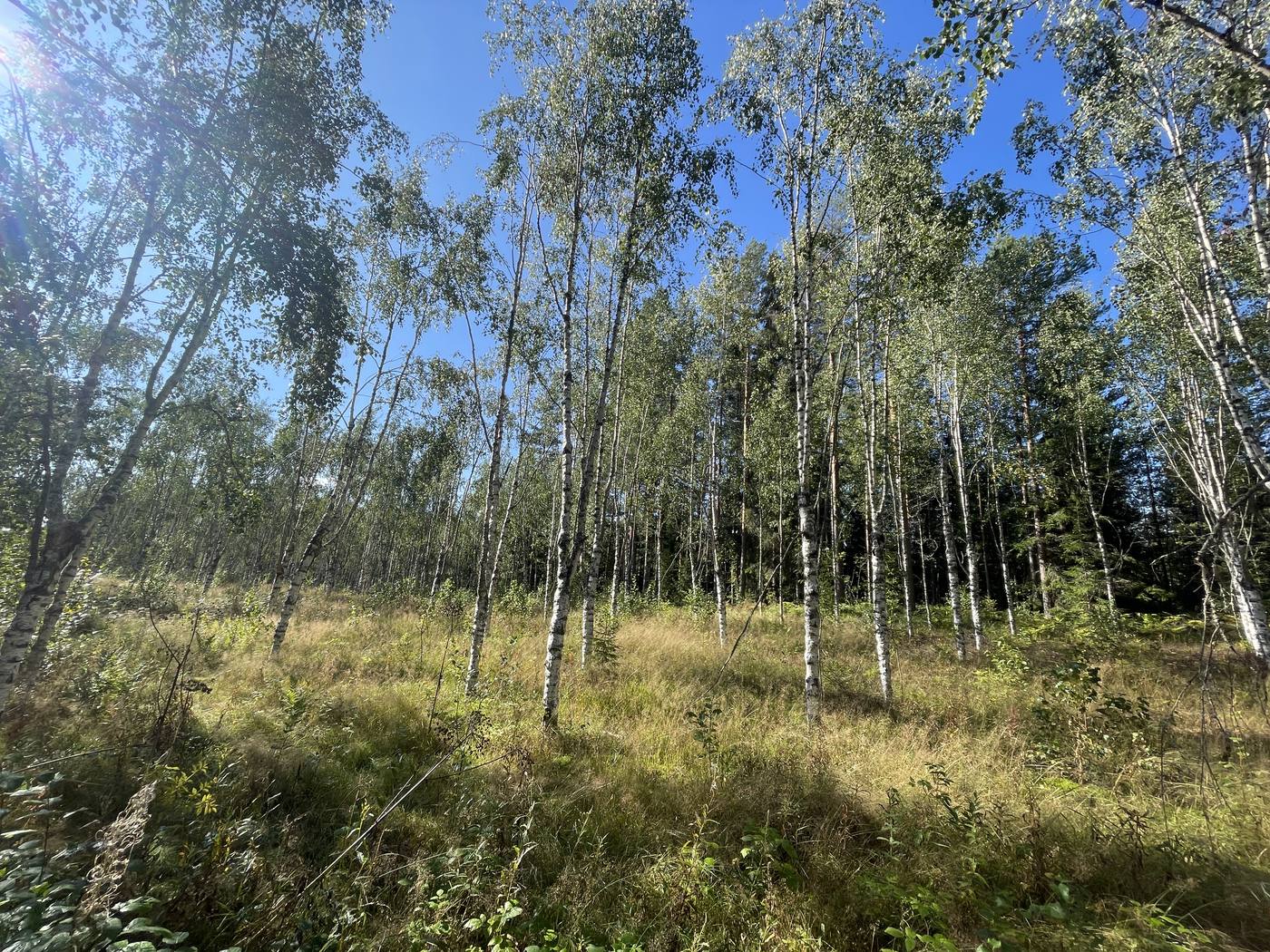
- Figured trees
- 1–2% of silver birch
- Specific gravity
- 0.65–0.68
- Janka hardness
- ~1,250 lbf
- Moisture on despatch
- 13–15%
- Felling season
- mostly November–March
- Drying
- 1–3 months, method dependent
What we sell
Logs
Sold by the standing tree or the felling batch, 13 to 25 cm diameter and 0.5 to 1.5 m long. Green or air-dried, for sawmills and larger workshops.
Slabs and boards
Live-edge, 10 to 25 cm wide, 15 to 50 mm thick, 0.5 to 1.5 m long. Every slab photographed individually.
See sizes, grades and what is in stock
Why buy direct
We see the whole log before it becomes anything. That means we know where in the stem a board's figure sat, how it ran through the log, and how it was dried. A reseller who bought a pallet at a trade fair knows none of that, which is why they often cannot tell you the moisture content.
It also means we can cut to order. Unusual dimensions, a specific figure density, or several matched boards from one log for a run of knife handles — all of that is a conversation rather than a catalogue lookup.
We would rather sell you nothing than sell you the wrong material.
How the wood is handled
Mostly felled in winter
November to March, when the ground is frozen and the sap is down: winter wood dries cleaner and stays paler, which is what makes the dark figure read. We keep felling and sawing through the rest of the year too, to keep pace with standing sales and orders.
Sawn to the figure
Each log is opened and assessed before it is cut. Two logs of the same diameter often get cut completely differently, depending on how the figure sits.
Air-dried, then kiln-finished
Mainly air-dried outdoors, with kiln-drying in autumn. Boards ship at roughly 13–15% moisture. Drying takes 1–3 months, depending on method.
Graded and photographed by hand
Every piece is graded off the sawn face, judged by eye, and photographed on both faces plus an angled shot. A flat photo of figured wood tells you nothing.
Who buys from us
Knife makers are the largest group, and they buy boards rather than pre-cut blanks, cutting their own scales and handle blocks from the slabs we send. Furniture makers and interior studios take the widest slabs. Sawmills and timber merchants buy logs in volume. Woodturners and luthiers do the same as the knife makers, cutting their own blanks to size.
We ship worldwide. Inside the EU that is straightforward; outside it we handle the export documents and phytosanitary certificates.
Tell us what you are making
Send the sizes, the quantity and the grade you have in mind, and we will tell you what we have and what it would cost to get it to you.
Prefer email? Write to hello@nordicmasur.com.